
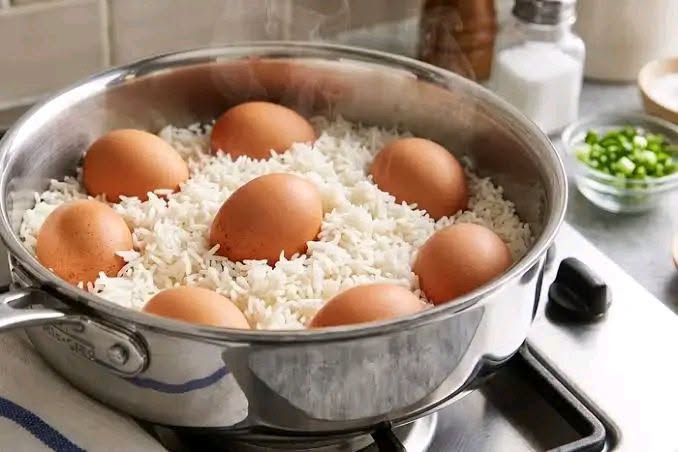

Registered dietitian-nutritionists have urged Nigerians to stop boiling unpeeled and unwashed eggs with rice in the same pot, citing the risk of cross-contamination and foodborne infections.
The experts explained that bacteria such as Salmonella and E. coli, which may be present on eggshells, can contaminate the rice during shared cooking. Although boiling eventually kills bacteria, the water passes through a warm stage before reaching boiling point, creating a window for pathogens to survive and transfer to the rice.
In exclusive interviews, the nutritionists noted that eggshells can crack while cooking, allowing egg white to spill into the rice and alter its appearance, taste and odour.
While acknowledging that some people combine the foods to save time, water, utensils and cooking gas amid high energy costs, the experts stressed that food safety must take priority. A foodborne infection, they warned, can lead to medical bills, lost work days and reduced productivity.
The warning follows a recent viral post on X in which users shared experiences of contamination after eating rice and eggs boiled together. Online findings show the practice remains common among many Nigerians seeking to cut costs and effort.
James Oloyede, a registered dietitian-nutritionist and former Director of Nutrition Services and Health Education at the Osun State Primary Health Care Development Board, said boiling eggs with rice is a recognised risk factor for cross-contamination.
“Cooking egg and rice together in the same pot has been found to be a risk factor in cross-contamination of certain bacteria, especially Salmonella, that can be found on the shell of the egg even after washing with the rice that is being cooked,” he said.
Oloyede explained that rice begins absorbing water as soon as it is added to the pot. If Salmonella is present, the bacteria can be taken up with the water and remain in the rice throughout boiling.
“The challenge with rice is that absorption begins to take place the moment you put your rice in the water. When the water begins to warm up, we see the rice grain begin to swell. What makes it swell is the absorption of the water. And if the egg contains Salmonella bacteria, the tendency is that when the rice is absorbing water, then the bacteria can also be absorbed together with the water and can remain throughout the process of the boiling,” he added.
He further noted that cracked shells can release egg white into the rice, affecting its quality. Some people attempt to reduce risk by tying eggs in nylon before placing them in the pot, but Oloyede insisted that cooking the foods separately remains the safest method.
“So it is important that, in a way to ensure food safety, we do not boil eggs together with rice in the same pot,” he said. “But of course, the safest way of cooking egg and rice is to boil them separately. That’s the safest way.”
He emphasised that the potential costs of a Salmonella infection—treatment, time off work and lost productivity—far outweigh any savings in gas or cooking time.
Charles Oguikpe, another registered dietitian-nutritionist, issued a similar warning. He said contaminants on eggshells, often originating from poultry droppings, can transfer to the rice even after washing.
“So the reason why we consider boiling eggs in the same pot while cooking rice on a sieve is that some contaminants in eggshells can cause harm to the human body because these contaminants will be dropped off on the rice. Contaminants like Salmonella or E.coli can drop off on the rice. That’s what we call cross-contamination,” Oguikpe said.
He noted that such contamination can cause stomach cramps, diarrhoea and fever, with severe cases potentially leading to kidney complications.
“These contaminants are from poultry droppings from the chickens that lay these eggs. No matter how you wash it, you might not be very sure 100 per cent that it has gone off,” he said. “So it is advisable that you boil your eggs separately and cook your rice separately. And when the egg has been boiled, the shells are removed. It becomes edible for us to eat.”
Both experts advised Nigerians to prioritise separate cooking of eggs and rice to minimise the risk of foodborne illness.