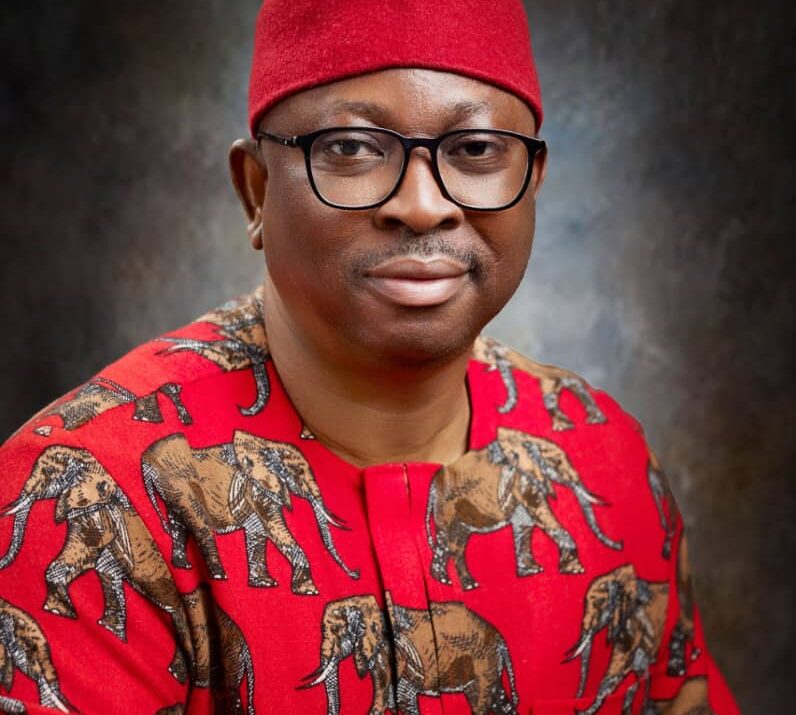

As Abia State stands poised upon the threshold of 2027, a new luminary has emerged from the commercial heartland of the South-East, bearing a message of redemption, a record of quiet service, and a vision so audacious it may yet reshape the political firmament of the region. Chief Eric Opah, the entrepreneur and philanthropist whose name has become synonymous with transformative generosity, has thrown his hat into the gubernatorial arena under the banner of the All Progressives Congress (APC).
There is a particular breed of silence that precedes epochal change. It is the hush that descends upon a people as they gaze upon the horizon and discern, with mounting certainty, the contours of a new dawn. In Abia State, that silence has been broken, not by the strident clamour of conventional politicking, but by the measured, deliberate footsteps of a man who has spent two decades constructing empires in the world of global logistics, only now to set his sights upon a far grander edifice: the redemption of his native soil.
Chief Eric Opah is not the archetypal Nigerian politician. He does not emerge from the shadowy recesses of godfatherism, nor does he owe his relevance to the capricious whims of political machinery. He is, by every estimation, a modern-day CEO—suave, urbane, and possessed of that rare charisma that commands boardrooms and village squares with equal facilities. He is the founder of thriving blue-chip enterprises, a titan of shipping and logistics industry, and a man whose business acumen has been honed across five countries and three continents. Yet, for all his corporate gravitas, it is his soul—anchored in the red earth of Nsulu, rooted in the communal ethos of Ngwa land—that has endeared him to the masses.
The journey to this pivotal moment has been neither swift nor fortuitous. In 2023, Dr. Opah sought the governorship ticket of the Peoples Democratic Party (PDP), only to be denied the nod by the party’s internal machinations. It was a setback that would have diminished lesser men, a bitter pill that might have soured the palate of ambition. But for Opah, it was but a detour on a predestined path. This year, in a turn of events that has sent ripples through the political waters of the state, he secured the gubernatorial ticket of the All Progressives Congress (APC)—a prize he now holds aloft as a sacred trust, not a personal conquest.
As Chief Charles Ogbonna, the APC chieftain who presented Opah to the party’s State Working Committee, emphatically declared: ” Opah is a man of honour, who has established himself in business in Africa and beyond.” The words, delivered with evangelical fervour at the party secretariat on Azikiwe Road, Umuahia, were met with thunderous approval from a large crowd of supporters who had accompanied their champion to formalise his declaration.
For his part, Chief Opah was characteristically measured, yet resolute, in his address to the party faithful. “My aspiration is not borne out of personal ambition. It is focused on clear agendas,” he intoned, his voice carrying the weight of conviction. “I am yearning for a more accountable government built on transparency and honesty.”
To understand the measure of the man, one must traverse the landscape of his achievements—a curriculum vitae that reads less like a career summary and more like a manifesto of excellence. Born into the storied lineage of Nsulu, Opah’s early years were marked by an insatiable thirst for knowledge and an uncommon drive for distinction. He obtained his Bachelor of Science degree in Business Administration, laying the foundation for what would become a storied career in the global logistics industry.
His professional odyssey commenced at the Panalpina World Transport Group, where he cut his teeth in the demanding world of international logistic business. His contributions have not gone unrecognised. He is an outstanding fellow of the Nigerian Institute of Logistics and a Fellow of the Nigerian Ports and Terminal Management Academy. In May 2023, the American Heritage University of Southern California conferred upon him an honorary Doctorate in Business Administration, in recognition of his commitment to industry and intellectual excellence. That same year, his peers saw fit to crown him The Sun Entrepreneur of the Year—a testament to his standing within the nation’s commercial elite.
Yet, for all his corporate laurels, it is in the quiet, unassuming corners of Abia where the true testament to Opah’s character resides. Long before the clarion call of 2027 entered public discourse, Dr. Opah was already deeply entrenched in the service of his people through the Eric Opah Foundation—the philanthropic vehicle through which he has channelled his considerable resources towards the upliftment of the less privileged.
The Foundation’s footprint is both extensive and profound. In healthcare, it has delivered free medical services through sustained missions, deploying physicians, essential medicines, and diagnostic equipment to underserved communities. During the dark days of the COVID-19 pandemic, when the world held its breath, the Foundation was at the forefront of providing critical medical provisions to vulnerable households.
In his hometown of Mbubo, he constructed the Obo-ogu Mbubo Civic Hall at considerable expense—a magnificent structure within whose walls operates a community hospital that has served Mbubo and its environs for over six years. For Opah, the vitality of the citizenry is not a political slogan; it is the foundational principle upon which any enduring prosperity must rest.
Education, however, holds a special place in his philanthropic pantheon. Proceeding from the immutable premise that no state can ascend where minds remain unilluminated, Opah has funded scholarships for Mbubo’s sons and daughters, extending his generosity to indigent students across Isiala Ngwa. Over twenty individuals have been sponsored through university, from matriculation to graduation, on the strength of his benevolence alone.
Most recently, he transformed the derelict Mbubo Secondary School into a modern smart institution, equipped with solar power and computers—an intervention that ensures learning proceeds unhindered by darkness or obsolescence.
His empowerment initiatives are equally substantial. Market women, farmers, and young artisans have all benefited from capital grants and working implements provided through his Foundation. His philosophy transcends mere alms-giving; he invests in capacity, training, and access, believing with every fibre of his being that dignity may be constructed, but never borrowed.
Where governance faltered, Opah stepped into the breach. He has graded rural thoroughfares, opened over thirty new rural roads, installed solar-powered street lights along the Ururuka highway in Isialangwa, and sunk boreholes across the region. These interventions were not undertaken for commendation or political capital; they were born of a conviction that neglect had become intolerable, and that the sons and daughters of Abia deserved better.
It is against this backdrop of service and sacrifice that Dr. Opah’s gubernatorial ambition must be understood. His aspiration for 2027 is not the acquisition of power for its own sake; it is a summons to redemption, anchored fundamentally upon the restoration of public trust, the judicious stewardship of resources, and the reclamation of Abia’s prodigious potential.
“Abia needs job creation, clear infrastructure, and someone who can unify the state,” Opah declared during his formal declaration, his voice resonant with purpose. “We don’t have two Abias. My aspiration is to industrialise Abia and utilise it as a model.”
His mission rests upon three cardinal pillars: governance rooted in integrity, economic reawakening, and investment in human capital. Upon his victory in 2027, he has pledged to entrench integrity in governance, eradicate waste, ensure the prompt remuneration of workers and pensioners, and re-establish accountability between government and the governed. Infrastructure enhancement, the cultivation of small and medium enterprises, and the creation of an enabling environment for commerce and industry shall be his watchwords—from the bustling markets of Aba to the administrative corridors of Umuahia, and indeed, every local government area in between.
Aba, the commercial epicentre of the South-East, occupies a special place in his vision. “Aba will then transcend its reputation as a trading emporium and emerge as a manufacturing colossus,” his campaign materials proclaim, and indeed, the ambition is not idle fancy. Opah has cited the renowned Canton Fair in China as a model for trade exhibitions that could be replicated in Abia, attracting investment and creating jobs on an unprecedented scale. He understands, perhaps better than most, the transformative power of commerce, having built his empire upon its principles.
“Today, APC is the government at the federal level,” Opah noted, underscoring the strategic importance of his party affiliation. “Abia needs that connection to develop. We are not going to be in opposition.” The logic is sound; a state aligned with the federal government is better positioned to attract federal projects, infrastructural interventions, and developmental partnerships.
The response to Opah’s candidacy has been nothing short of electric. Across Abia, from the trading floors of Aba to the village squares of Isiala Ngwa, his name has become a rallying cry for those who yearn for a departure from the politics of the familiar. His appeal transcends ethnic and generational divides, resonating with traders and technocrats, students and elders, artisans and professionals alike.
For his part, Opah has extended a humble entreaty to all Abians, and particularly to those who ran unsuccessfully at the recent primaries, urging them to transcend divisions and subordinate personal ambitions. “We must coalesce around this noble mission,” he appeals, “convinced that only through unity of purpose shall Abia attain the redemption she so richly deserves.”
The year 2027 presents Abia with a choice—a stark, unambiguous decision between the perpetuation of the status quo and a deliberate course correction toward renewal. Those who have observed Dr. Eric Opah over the years know that his character has been revealed in seasons when no audience was present, in the quiet hours of service when the cameras were off and the applause was absent. Now, he seeks the mandate to extend across the entire state the same diligent service he has rendered in obscurity for years.
He is a man of untainted character in an arena where reputations are often sullied. He is a billionaire by any standard, yet possessed of a humility that is disarming. He is a devoted family man, married to his beloved wife, Mrs. Christiana Opah, and blessed with three lovely children—a father whose values are rooted in the timeless traditions of his people.
As the campaign for 2027 gathers momentum, one thing remains certain: the mission is clear, the man is well known across Abia, and the moment has arrived. The people of Abia must now decide whether they are prepared to assume their rightful place in the politics of Nigeria, to enhance the state’s economic and infrastructural fortunes, and to entrust their destiny to one who has already proven, through deeds in rather than words, that he is capable of delivering the Abia of their dreams.
The year 2027 beckons. Tomorrow, it appears, has finally come.