
…As PDP NASS Candidates Declare Support For APC Candidates
Minister of the Federal Capital Territory (FCT), Nyesom Wike, on Monday declared that he would lead the campaign to secure President Bola Tinubu’s re-election in the FCT as well as Rivers State in 2027, unveiling a cross-party mobilisation strategy involving stakeholders of the All Progressives Congress (APC) and the Peoples Democratic Party (PDP).
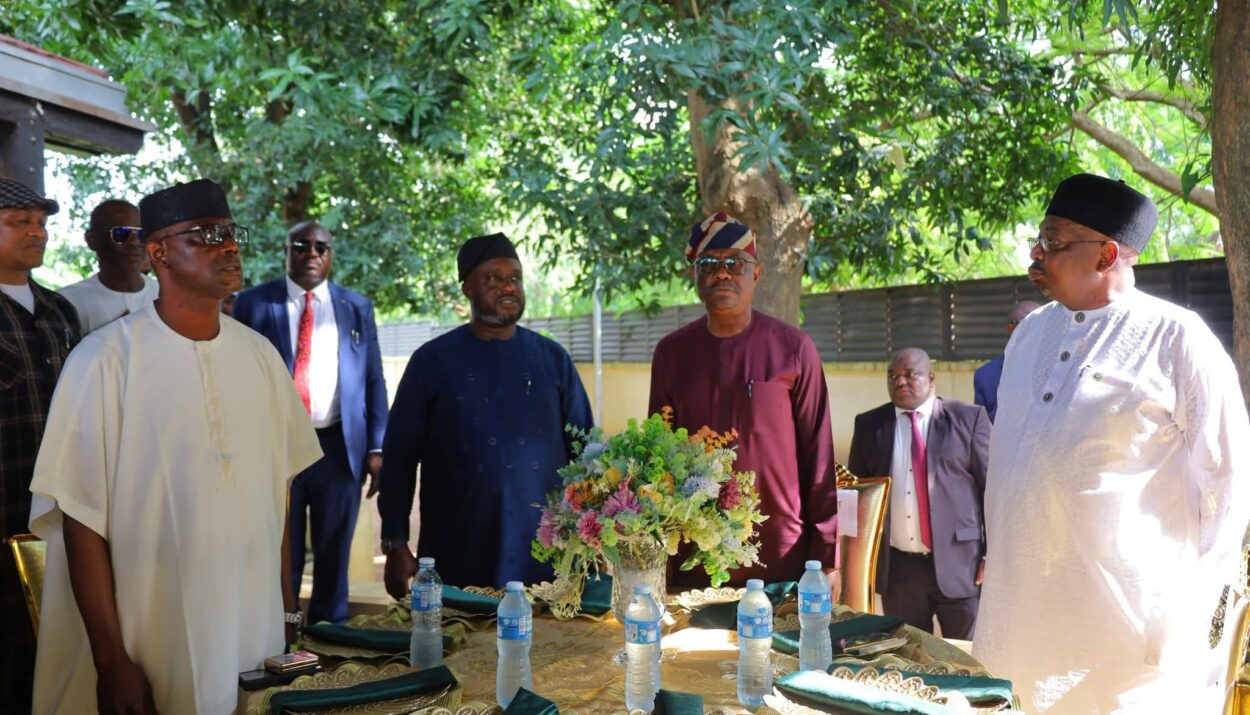
Wike, who spoke at a stakeholders’ meeting of the Rainbow Coalition in Abuja, described himself as the coordinator of the president’s re-election campaign in both FCT and Rivers State, insisting that political differences would not prevent members of the two parties from working towards a common presidential objective.
The minister said in the FCT, the coalition had agreed to support Tinubu’s re-election as well as the APC Senatorial and House of Representatives candidates.
“For the presidency, all of us have agreed that it is Bola Ahmed Tinubu. I am going to coordinate the FCT and Rivers State. So you can imagine how important it is,” he said.
“I am in charge of the FCT election. I am the commander of field operations as far as the FCT election is concerned.”
The meeting, which saw the PDP National Assembly candidates openly declaring support for the APC candidates, brought together APC and PDP stakeholders, including party chairmen, serving and former senators, candidates for the National Assembly and leaders from the six area councils of the FCT.
Wike said the gathering was designed to establish a common political front ahead of the 2027 general election and ensure that stakeholders understood the coalition’s objectives, regardless of the parties they might belong to in the coming months.
“I want to let all of you know that we are going to work together. Nobody should say, ‘I am PDP’ or ‘I am APC.’ For the purpose of this election, we are together,” he said.
The former Rivers State governor cited the 2024 Edo State governorship election as evidence that political coalitions could determine electoral outcomes, claiming that cooperation between elements of the APC and PDP had helped prevent the incumbent governor from installing a successor.
He said the experience reinforced his belief that political alliances could succeed when stakeholders agreed on a common objective.
Wike, however, clarified that the arrangement was primarily focused on the presidential election, leaving participating parties to determine their positions on other contests.
Making a case for Tinubu’s re-election, Wike challenged political leaders to identify any of the six area councils of the FCT that had not benefited from the administration’s infrastructure projects and institutional reforms.
He cited the establishment of the FCT Civil Service Commission, the appointment of an FCT Head of the Civil Service from within the territory’s workforce and the creation of the Women Affairs and Youth Development Secretariats as evidence of changes under the Tinubu administration.
According to him, the reforms had created opportunities for career progression among FCT civil servants and expanded participation in governance.
On infrastructure, the minister listed road construction and rehabilitation, school renovations, police stations and other public facilities among the projects being executed across the territory.
He expressed confidence that the administration’s performance would provide a strong basis for mobilising residents behind the president in 2027.
Wike also defended Tinubu’s economic reforms, acknowledging that some decisions had imposed temporary hardship but arguing that difficult measures were necessary to address longstanding economic problems.
“Changing the economy of a country is not like a prayer,” he said, adding that the benefits of economic reforms might not be immediate.
He further expressed support for the proposed establishment of state police, describing it as an important measure for tackling Nigeria’s security challenges.