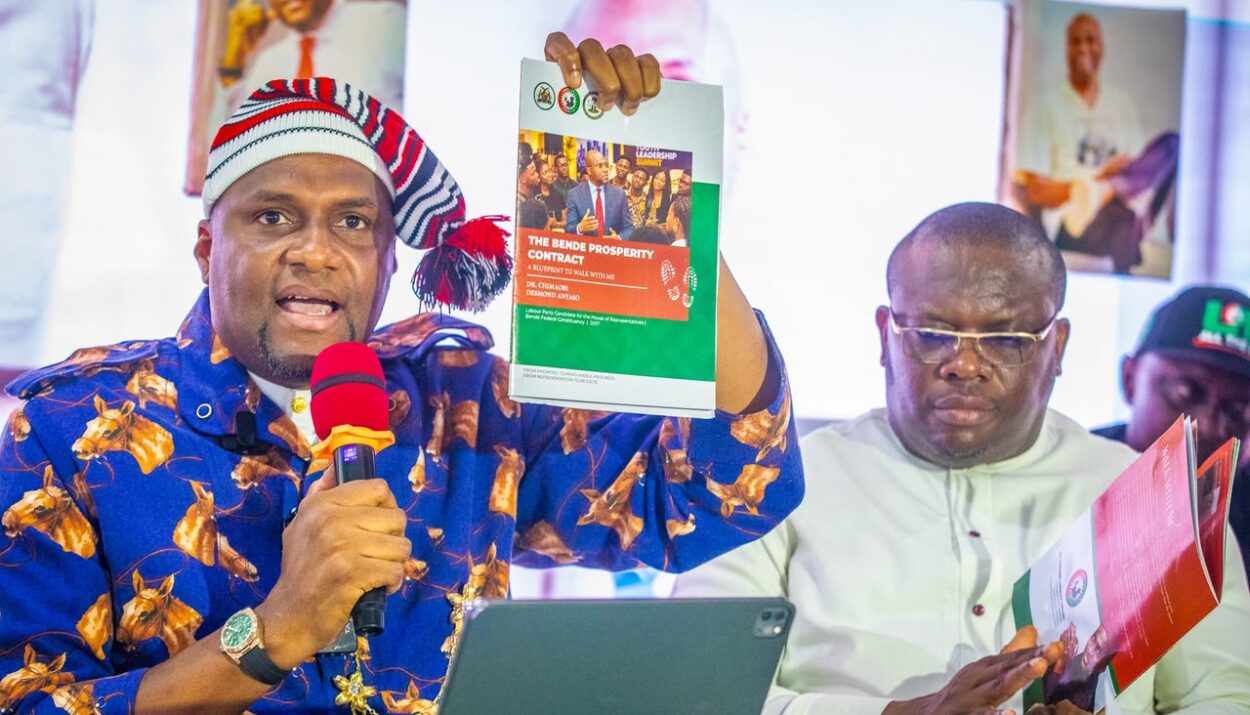

1. For weeks, the political conversation in Bende Federal Constituency has revolved around what candidates seeking the mandate of the people intend to do if elected. While manifestos have traditionally been the preferred vehicle for communicating campaign promises, Dr. Chima Anyaso has chosen a different route: a document he describes as the Bende Prosperity Contract, tagged “Walk With Me.” The document goes beyond broad political declarations by presenting a series of commitments across sectors and placing emphasis on accountability, measurable outcomes and continued engagement with constituents.
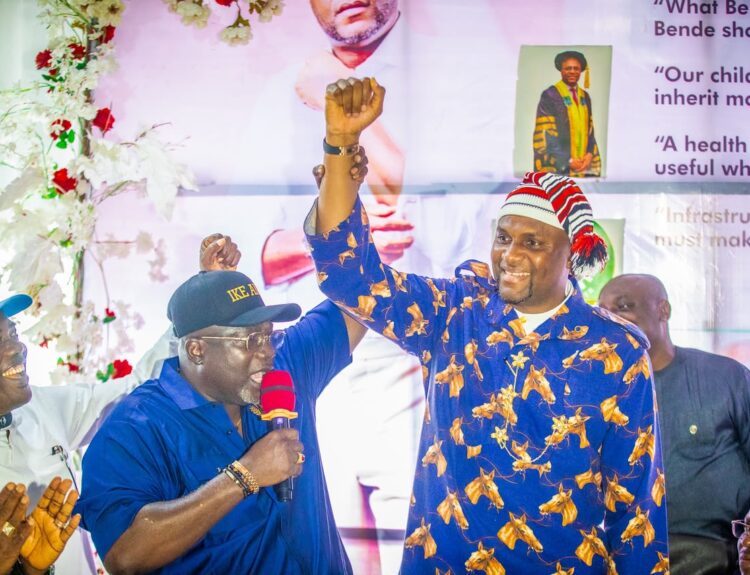
2. The public presentation and signing of the Bende Prosperity Contract took place at the Uzuakoli Civic Centre in the presence of traditional rulers, community leaders, President Generals, political stakeholders, religious leaders and other representatives from across Bende Federal Constituency. The document isa development blueprint covering agriculture, education, healthcare, infrastructure, youth development, enterprise, women and inclusion, sports, security and environmental sustainability.
3. The significance of the document lies partly in its framing. Rather than presenting representation as a personal favour from an elected politician to constituents, the contract repeatedly describes ‘public resources’ and government interventions as belonging to the people. That distinction is central to the political philosophy expressed in the document: the representative is expected to pursue opportunities on behalf of the constituency and report back to the people who entrusted the mandate to him.
4. This approach is captured in the section titled “Walk With Me: A New Model of Representation.” The document argues that Bende cannot afford a representative trapped in political quarrels while the people wait for development. It proposes a model based on building relationships, speaking up for Bende, negotiating for opportunities, collaborating with institutions and partners, reporting back to constituents and protecting public trust.
5. The document’s central message is therefore not simply that Dr. Chima Anyaso wants to go to Abuja. It is that, if elected, he intends to maintain a relationship with Bende while operating from Abuja. The distinction is important because representation is not limited to occupying a legislative seat; it also involves identifying opportunities, pursuing interventions, monitoring implementation and communicating with constituents.
6. Under the proposed model, political differences should not become barriers to development. The contract states that cooperation should be sought wherever such cooperation can bring legitimate development opportunities home to Bende. It proposes engagement with federal ministries and agencies, the National Assembly, state and local governments, development organisations, universities, traditional institutions, community leaders, the private sector and members of the Bende community in the diaspora.
7. One of the most direct statements in the document is the principle: “I will not ask Abuja who you voted for before I ask what Bende needs.” That sentence captures the promise of a representation model in which access to government opportunities is not presented as something that should depend on political affiliation.
8. The contract further breaks this philosophy into practical responsibilities: build relationships across parties, ministries, agencies, institutions and the private sector; speak up whenever decisions affecting Bende are being made; negotiate for the constituency’s legitimate share of public opportunities; collaborate with state, local, traditional, academic, development and diaspora partners; and report back to the people.
9. Reporting back is particularly significant because the document says constituents should know what is being pursued, what has been achieved and what has been delayed. This suggests a representation model in which communication is treated as part of accountability rather than merely a campaign activity that ends after an election.
10. The contract also contains an explicit position on public resources. It states that what is secured in Abuja does not personally belong to the representative but belongs to Nigerians, including the people of Bende where applicable. The document consequently rejects the idea of turning public resources into private property or treating government opportunities as personal favours.
11. The philosophy extends to what the document describes as “our share.” In this context, the phrase refers to legitimate public opportunities and interventions that the representative would seek to attract to the constituency. The contract says the representative’s responsibility would be to pursue that share and work to bring it home rather than treat it as a personal entitlement.
12. This is where the contract’s emphasis on relationships becomes particularly relevant. The document recognises that a federal legislator does not operate in isolation and cannot personally execute every development project. The representative’s role includes advocacy, legislative action, oversight, negotiation, relationship-building and facilitating access to institutions capable of delivering interventions.
13. Agriculture is one of the areas where the document attempts to connect Bende’s existing economic potential with a broader development strategy. Its philosophy is expressed in the phrase “From farm to factory. Grow it here. Process it here. Sell it here. Create jobs here.” The emphasis is on reducing the economic gap between production and processing.
14. The contract identifies crops and agricultural activities across several parts of Bende, including cassava, yam, rice, maize, vegetables, fruits and palm produce. It argues that when raw agricultural products leave the area without sufficient local processing, much of the value associated with those products is created elsewhere. Its proposed response includes processing centres, improved equipment, better seeds, storage facilities and access to finance.
15. The agricultural proposal also illustrates the document’s broader development philosophy: identify what Bende already possesses and create systems that can convert those resources into income, jobs and investment. The idea is not to treat development as something that must always be imported from outside but to build around the economic resources already available within the constituency.
16. Education is another major pillar. The document describes education as an investment in the mind and argues that every Bende child should have a fair start. Its proposals include improved classrooms, better learning materials, science and computer laboratories, libraries, teacher support, scholarships and assistance for children who are less privileged or living with disabilities.
17. The education proposal also recognises that infrastructure alone does not produce educational outcomes. Teachers, learning tools and access to opportunities are equally important. The contract therefore places emphasis on teacher development, functional facilities and educational support, while promising that progress should be verified and reported rather than simply announced.
18. For young people, the contract adopts a different language from the traditional political description of youth as a demographic to be mobilised during elections. It describes young people as Bende’s greatest resource and proposes skills development, apprenticeships, entrepreneurship support, digital opportunities, mentorship and access to lenders and investors.
19. The proposed Bende Youth Council is particularly notable because it seeks to give young people a formal seat at the table. The idea is that youth participation should extend beyond campaign rallies and political mobilisation into conversations about policy, development priorities and opportunities.
20. Digital connectivity also features prominently in the youth proposal. The contract argues that a young person in Nkpa, Ozuitem or another rural community should be able to access learning and economic opportunities online just as a young person in Umuahia or Lagos can. Better telecommunications and internet access are therefore presented as economic infrastructure rather than merely convenience.
21. Healthcare is framed around proximity and functionality. The document’s central idea is “No Family Left Without Care.” It proposes strengthening existing healthcare facilities before creating structures that may become difficult to sustain, with attention to equipment, medicines, electricity, water, staffing and basic healthcare services.
22. The healthcare proposals include maternal and child health, antenatal and postnatal services, immunisation, rural medical outreach, eye and dental services, hypertension and diabetes screening, preventive health education, digital health and emergency preparedness. The document also proposes partnerships as a way of expanding the reach of interventions.
23. The contract introduces a practical test for healthcare interventions: how many facilities are functioning, how many people are being served and what has actually improved. That measurement-based approach runs through several sections of the document and reflects its broader insistence that representation should be judged by results rather than speeches.
24. Infrastructure is similarly treated as an economic issue rather than simply a collection of construction projects. Roads should connect farms to markets, communities to schools, patients to hospitals and businesses to customers. Electricity should support productive activities, while water and digital connectivity should make communities more functional.
25. The document proposes advocacy for roads, rural electricity, solar solutions, boreholes, clean water, telecommunications, internet connectivity and improved markets. It also links infrastructure with the ability of farmers, traders, students, health workers and entrepreneurs to operate more effectively.
26. Enterprise development forms another part of the Bende Prosperity Contract. The document recognises that government cannot directly employ everyone but argues that government can help create conditions in which businesses can start, survive and grow. It proposes access to finance, entrepreneurship training, digital commerce, financial literacy, business registration, branding and marketing.
27. It also proposes connecting Bende entrepreneurs with banks, government agencies, universities, development organisations and diaspora investors. The underlying objective is to move local enterprise beyond survival and toward growth, wider markets and job creation.
28. Then comes a particularly important section of the contract: Women, Sports and Inclusive Opportunity. The document begins from the position that development must reach everyone, including women, young people, persons living with disabilities, traders, farmers and artisans.
29. On women, the document proposes greater representation in leadership and decision-making, fair and transparent affirmative-action measures where appropriate, improved access to finance, skills, markets and entrepreneurship opportunities, scholarships and mentorship for girls, and stronger support for women in agriculture and small businesses.
30. Its statement that “Women should not have to work twice as hard to receive half the opportunity” captures the document’s argument that inclusion should be practical. The objective is not merely to celebrate women during political events but to expand their access to leadership, education, enterprise and economic opportunity.
31. The contract also addresses the rights and inclusion of people living with disabilities. It references existing Nigerian legal protections and proposes greater attention to implementation and oversight. Its stated position is that no person living with a disability should be excluded from education, employment, public life or economic opportunity because of disability.
32. The document therefore treats inclusion as a development issue. Its stated promise is that nobody should be left behind because of gender, disability, poverty or lack of access to opportunity. It presents a prosperous Bende as one in which every woman has a voice, every young person has a chance, every person living with a disability has dignity and every talent has an opportunity.
33. Sports and talent development receive a dedicated section. The contract recognises that Bende has young people with potential in football, athletics, basketball, volleyball, table tennis, traditional sports, music, film, the arts and digital content.
34. Its proposed interventions include community sports grounds, grassroots competitions, links to academies, scouts and educational pathways, as well as support for creative talent. The underlying principle is simple: talent requires space, coaching, exposure and opportunity if it is to develop into excellence.
35. The contract specifically proposes working with relevant government agencies, sports bodies, cultural organisations and private partners to identify talented young people and connect them with coaching, competitions, mentorship, scholarships and other opportunities. It also recognises digital and creative industries as emerging pathways for young people.
36. Another distinctive proposal is the establishment of an annual Bende Festival of Arts and Culture. The document sees Bende’s cultural heritage as an asset capable of supporting community identity, tourism and local enterprise. Music, food, masquerades, history, crafts and creative talent could become part of a platform that also creates economic opportunities.
37. The proposal is significant because cultural development is often left outside conventional political conversations about roads, schools and healthcare. Yet culture can support tourism, creative industries, small businesses and community cohesion. The contract consequently places cultural expression within its broader prosperity agenda.
38. Security is another pillar of the document. It begins with a recognition that keeping people safe is principally the responsibility of the police and other security agencies, but argues that elected representatives can still support the conditions required for effective security.
39. The proposed areas include better security infrastructure, public lighting, communication and emergency systems, as well as stronger cooperation between communities and security agencies. It also mentions first-aid training, road safety and emergency preparedness so that communities are better prepared when emergencies occur.
40. The security proposal is closely connected to the environmental agenda. The document’s message is expressed in three short imperatives: “Protect the people. Protect the land. Protect the future.” It treats the safety of communities and the protection of the physical environment as connected responsibilities.
41. On the environment, the contract identifies erosion, flooding, land degradation and failing drainage systems as challenges capable of affecting homes, farms, roads, businesses and entire communities. It proposes sustained federal attention, assessments of severely affected sites and engagement with relevant environmental agencies.
42. The environmental section specifically proposes stronger attention to erosion control, flood management and environmental protection, including improved mapping of vulnerable areas, better drainage and watershed management, rehabilitation of degraded land, protection of riverbanks and catchment areas, early-warning systems and stronger enforcement of environmental standards.
43. The contract also proposes cooperation between the Abia State Government, federal agencies, traditional institutions, communities and development partners. Its argument is that environmental intervention should not come only after disaster strikes. The approach should move from emergency response toward prevention and long-term solutions.
44. Tree planting, cleaner communities, responsible waste management and more sustainable farming are also mentioned. These proposals connect environmental protection with the question of what future generations will inherit. The document’s central environmental test is whether today’s generation can leave the land to its children without passing unresolved ecological problems to them.
45. Across these different sectors, one principle remains consistent: representation should be connected to measurable responsibilities. Whether the issue is agriculture, education, healthcare, infrastructure, enterprise, women, sports, security or the environment, the contract repeatedly asks what problem an intervention solves, who benefits and how success will be known.
46. This is perhaps the strongest feature of the “Walk With Me” philosophy. It seeks to change the relationship between representative and constituent from one based primarily on occasional political appearances to one based on continuous communication. The proposed relationship is that of a representative who explains what is being pursued, what has been achieved, what remains unfinished and where challenges have occurred.
47. The contract also carries a political principle concerning tenure and rotation. Dr. Chima Anyaso states that he would not seek a third term if elected and links that commitment to what he describes as an understanding between the Umunna and Ikwuisii blocs. Reports from the October 6 presentation also identified the two-term pledge as one of the major features of the document.
48. Whether voters ultimately accept or reject any political proposal is a matter for the electorate, but the structure of the contract gives them something concrete to examine. Instead of evaluating only speeches, slogans and campaign appearances, constituents can examine the specific commitments contained in the document and later measure any elected representative against them.
49. That is ultimately what makes the Bende Prosperity Contract different in presentation from an ordinary campaign manifesto. It is designed as a reference document: a statement of proposed priorities, principles and commitments that the people can read, question and retain. The public reports on its unveiling similarly describe it as an attempt to make proposed representation measurable and accountable.
50. So, while some may have been waiting for another conventional manifesto filled with political promises, Dr. Chima Anyaso placed before Ndi Bende a document that asks a more demanding question: What should representation look like when the people have the opportunity to hold their representative to specific commitments? From women and inclusion to sports and talent, from security to environmental protection, and from agriculture to the broader model of representation, the Bende Prosperity Contract attempts to answer that question in detail. Its ultimate test, however, would not be the ceremony at which it was signed, but the extent to which its commitments could be translated into measurable outcomes if the electorate gives the candidate the mandate he seeks.
Promise Uzoma Okoro, anipr is
Director of Media and Publicity, Chima Anyaso Campaign Organization