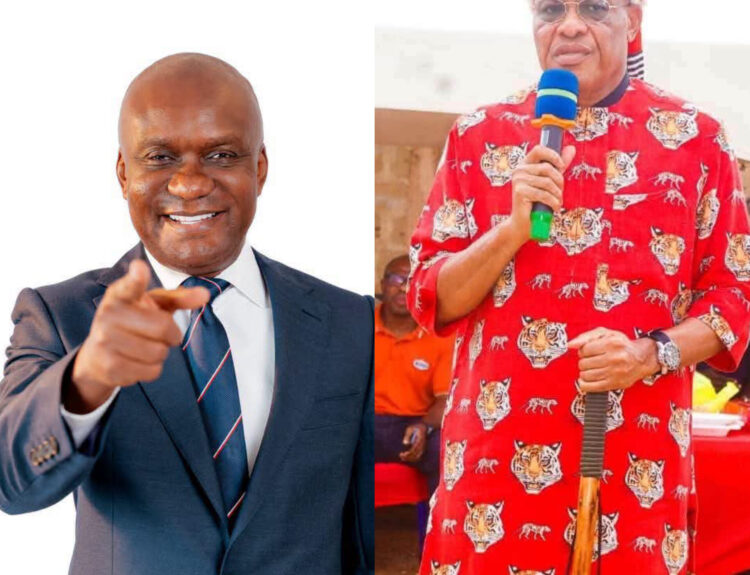


The Mandate 27 Group has defended the former Speaker of the Abia State House of Assembly, Rt. Hon. Chinedum Enyinnaya Orji, over allegations that he failed to publicly advocate for the release of the detained leader of the Indigenous People of Biafra (IPOB), Mazi Nnamdi Kanu.
The group maintained that Orji pursued institutional engagement and diplomatic channels rather than social media publicity in addressing issues surrounding Kanu’s detention and the security challenges confronting the South-East.
In a statement responding to a Facebook post attributed to one Godwin Asiegbu, who questioned Orji’s position on Kanu’s ordeal, the group described the criticism as a misunderstanding of legislative responsibilities and the role of institutional diplomacy in resolving sensitive national issues.
According to the group, Orji, who served as Speaker of the Abia State House of Assembly from June 10, 2019, to June 10, 2023, participated in the Conference of Speakers of State Legislatures of Nigeria, a body comprising Speakers of the 36 State Houses of Assembly.
The group argued that the Conference provided an important platform for discussing national security concerns and advocating political solutions to issues affecting the country.
It recalled that between 2021 and 2022, several prominent political institutions in the South-East, including the South-East Governors’ Forum and the South-East Caucus of the National Assembly, advocated dialogue and political engagement as possible approaches to resolving Kanu’s detention and the growing insecurity in the region.
The statement specifically referenced a meeting of the South-East Caucus of the National Assembly held on September 15, 2021, at the residence of former Deputy Senate President Ike Ekweremadu.
According to the group, the lawmakers resolved to establish a committee to engage relevant stakeholders, the Federal Government and its agencies towards finding a political solution to Kanu’s detention.
It further noted that the South-East Governors’ Forum had similarly expressed support for exploring political options in addressing the matter.
The Mandate 27 Group maintained that Orji’s participation in the Conference of Speakers placed him within the broader institutional discussions on security reforms, dialogue and political engagement.
The group, however, did not provide a specific communiqué establishing that Orji personally initiated or sponsored a resolution concerning Kanu.
Addressing questions about Orji’s limited public commentary on the issue, the group argued that sensitive security and judicial matters sometimes require confidential engagement rather than public declarations.
It cited the approach of the Deputy Speaker of the House of Representatives, Rt. Hon. Benjamin Kalu, who has publicly advocated political engagement over Kanu’s case.
The group maintained that Orji’s decision not to engage extensively in social media debates should not be interpreted as indifference to the concerns of the Igbo people.
It also referenced legislative interventions by other federal lawmakers, including Hon. Obi Aguocha, who advocated a political solution to Kanu’s detention.
According to the statement, despite differences in approach, the central objective of the various interventions remained the pursuit of dialogue and political resolution.
The group further referred to Kalu’s renewed call for presidential intervention following the Federal High Court’s November 2025 judgment sentencing Kanu to life imprisonment.
It argued that the development reinforced the importance of political engagement alongside available legal processes.
Speaking on Orji’s legislative record, the group highlighted the passage of the Abians in Diaspora Commission Law during his tenure as Speaker, describing it as part of his administration’s efforts to strengthen the relationship between Abia State and its citizens living outside the country.
The group insisted that Orji had consistently demonstrated concern for the welfare and interests of the Igbo people through legislative responsibilities and institutional engagement.
“Rt. Hon. Chinedum Enyinnaya Orji spoke through the Conference of Speakers of 36 states, not through Facebook. He chose political solutions through institutional communiqués, not social media razzmatazz,” the statement read.
The group also criticised what it described as the politicisation of Kanu’s predicament, warning against using the sensitive issue to score political points or attract social media attention.
It maintained that meaningful advocacy should be measured by constructive engagement and the pursuit of practical solutions rather than the volume of public statements made by political figures.
“Rt. Hon. Chinedum Enyinnaya Orji talks where men talk. He does not chase clout or make political entertainment out of a predicament that affects the Igbo nation,” the group stated.
The Mandate 27 Group consequently urged critics to examine the resolutions and communiqués issued by the Conference of Speakers, the South-East Governors’ Forum and the South-East Caucus of the National Assembly between 2021 and 2023 before drawing conclusions about Orji’s position.
It reaffirmed its position that the former Speaker’s approach reflected a preference for institutional diplomacy over public political confrontation, insisting that his commitment to the interests of the South-East should not be judged solely by his social media presence.